Luminatory
Chasing SunlightThe Luminatory is the innermost audience chamber of the Palace and the setting in which Jonathan Heights is brought into direct contact with the Illuminated King. Its decisive significance lies in the way its physical design makes the regime’s ideology perceptible: light is not merely illumination but authority, purity, surveillance, and the claimed foundation of human civilization in a world defined by eternal darkness.
Architecture and Atmosphere
The chamber lies within the Palace’s central tower, a spiraling structure rising above the outer curtain wall. Jonathan Heights reaches it only after being escorted past the lesser offices and through the enormous inner courtyard, an unexpectedly direct procession that makes him suspicious. He had anticipated bureaucratic delays, bribery, insincere compliments, and veiled warnings, but instead he is taken toward the center of royal power without the ordinary administrative obstacles.
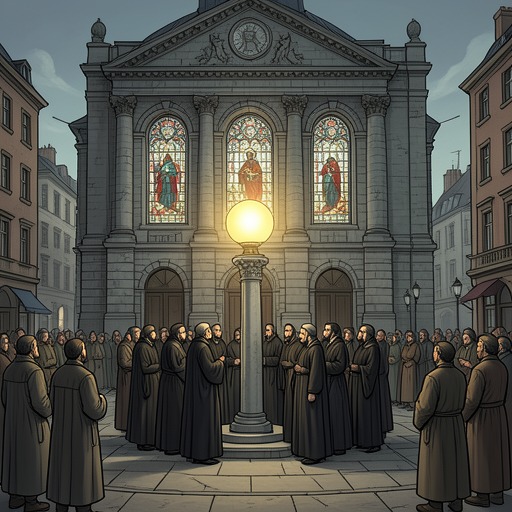
The Luminatory itself is structurally simple. It is carved from stone and contains a petitioner’s dais at the center and a raised balcony at the far end. Its severity is intensified by the absence of ornament: there are no decorations to distract the eye, only zint-light and a shrine-like concentration on the light of zint and the King who wields it. The room’s simplicity therefore does not make it neutral. It strips away competing meanings until the state’s sacred symbol becomes the chamber’s entire visual and political language.
Ritual of Audience
The Luminatory imposes a formal sequence on Jonathan Heights. Heavy steel doors are opened by guards turning a wheel together, and Jonathan enters before ascending the steps to the petitioner’s dais. A tone signals the beginning of the audience; he kneels with his head lowered, not because he is the Illuminated King’s most fervent supporter, but because open disrespect would be dangerous.
The ritual depends on controlled uncertainty. Jonathan hears no movement and observes no change in the lighting, yet the hair on the back of his neck prickles, telling him that he is no longer alone. The invisible arrival is followed by the King’s resonant command, “You may rise,” a voice described as deep enough to be felt in Jonathan’s bones. The chamber thus turns the petitioner’s body into an instrument of recognition: he waits, kneels, rises, and looks upward according to a power whose presence precedes its visible appearance.
The King and the Doctrine of Light
The Illuminated King appears without the spotlights that ordinarily make him radiant atop the Palace walls, but he remains cloaked in radiance. His brightness washes out his features, producing what Jonathan perceives as a silhouette in reverse. The absence of a recognizable face makes the King less a conventional individual than an embodied principle, while the fact that Jonathan can look directly at him introduces an uneasy comparison with the sunlight Jonathan claims to have seen.
This encounter belongs to the broader political order in which the Illuminated King, the Reflected Council, and the Inquisition define human civilization against the darkness beyond its borders. The surrounding human territories describe eastern lands and nonhuman peoples as savage or dangerous, while places such as Danby’s Point expose the instability of that boundary. The Luminatory condenses the same opposition into a single room: zint-light fills every surface, shadows are denied, and the King’s authority appears as an overwhelming extension of illumination itself.
Jonathan Heights at the Threshold of Power
The audience begins when the Illuminated King addresses Jonathan Heights by name and states that the crown has learned he is financing an expedition eastward. The expedition is directed toward lands no sane and god-fearing person would visit, because Jonathan insists that sunlight is real despite its being treated by others as a laughable myth. The Luminatory therefore functions as a threshold between Jonathan’s private conviction and the institutions that claim the right to regulate knowledge, travel, and contact with the unknown.
Its significance deepens retrospectively. Jonathan’s journey carries him through human borderlands, alien settlements, ruined cities, ritual deaths, and the Arch of Khokorron before he finally crosses into Bright Defile. At the Arch, passage demands a unique payment of knowledge or life; at the Luminatory, passage into royal presence demands bodily submission to an order that presents itself as absolute light. By the end, Jonathan sacrifices his cane and crosses into sunlight, an act that places the Luminatory’s purified zint-world in contrast with the open sky and living radiance of Bright Defile. The chamber is therefore an early image of the light Jonathan must pass beyond: powerful, totalizing, and incapable of containing the truth he seeks.